
Hostility, Heresy, & C.S. Lewis
 My wife Heidi and I had the pleasure of attending The C. S. Lewis Institute conference a few weeks ago. Lewis’ book Mere Christianity was the topic. It had been a few years since I’d read the book, and it seemed like a good way to get a refresher course on one of the 20th century’s great Christian thinkers.
Dr. Chris Mitchell, a professor at Wheaton College, led us through five fascinating lectures. I had not realized that Mere Christianity was originally a series of radio addresses that were given over the BBC during World War II. I also hadn’t previously known what it cost Lewis to clearly proclaim his faith to over a million listeners.
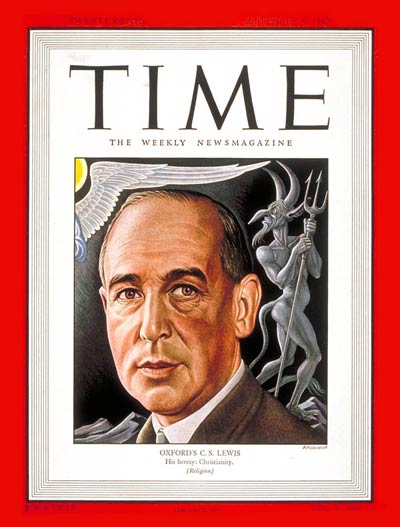
We often think that the world’s hostility toward faith in Christ is worse now than in our parents’ day. Not so. In 1947, Lewis’ picture appeared on the front cover of Time magazine. The headline read:
“OXFORD’S C.S. LEWIS, His Heresy: Christianity.”
Lewis was disdained by many at Oxford because he spoke publicly of his faith in Christ. Their attitude seemed to be it’s fine to be a Christian, but not to speak of it in public – and certainly not in academia.
Dr. Mitchell also read a startling quote from authoress Virginia Woolf. After a meeting with T. S. Elliot during which he told her he was now a follower of Christ, she wrote:
“I have had a most shameful and distressing interview with dear Tom Elliot, who may be called dead to us all from this day forward. He has become an Anglo-Catholic believer in God and immortality and goes to church. I was shocked. A corpse would seem to me more credible than he is. I mean, there’s something obscene in a living person sitting by the fire and believing in God.”
That quote is from the year 1928. I was reminded of Jesus words in John 15:18 – 20, “If the world hates you, keep in mind that it hated me first. If you belonged to the world, it would love you as its own. As it is, you do not belong to the world, but I have chosen you out of the world. That is why the world hates you. Remember the words I spoke to you: ‘No servant is greater than his master.’”
Our brains must be close together in the body of Christ. I’ve been following RBC through audio sermons and small groups (looking to attend service this Sunday for the first time) and coincidentally, I am currently half way through reading Mere Christianity for the first time. It’s these slight coincidences that have me thinking, “I must be on the right path for once in my life.”
Excellent reminder, Ed. I wonder if C.S. Lewis framed the Time cover page as an encouragement! Then his visitors who saw him as a heretic could also see him as a fool, which would be encouraging too, since according to I Corinthians 1:18 “the word of the cross is to those who are perishing foolishness!”
Hi Ed,
Forgive my tardiness in reading your post. Thank you for highlighting Clive Staples’ struggles as I’d not yet seen the TIME cover, but knew peripherally of his acquaintance with grief and troubles as a convert – truly, no cakewalk of a faith journey. “A Grief Observed” codified the loss of his American love and was solace to my saddened soul about 7 years ago. (Ya know he died the same day that JFK was shot?)
Ahhh, as the fabric of history weaves in and out, as do those who impact our lives…
NCD